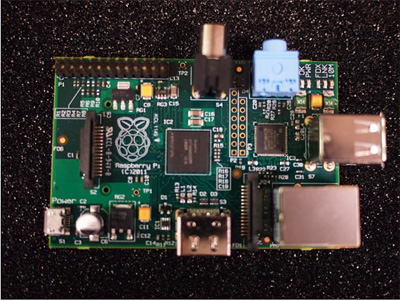
Regular readers to this blog will be aware of the coverage that I have devoted in the past to a company called Raspberry Pi, a spin out from that UK hive of cerebral activity, Cambridge University (Cambridge, UK).
The engineers at Raspberry Pi have developed, and are now selling, a small inexpensive Arm (Cambridge, UK) based computer that plugs into a TV and a keyboard. It's a capable little PC which can be used for many of the things that a desktop PC does, like spreadsheets, word-processing and games. It also plays high-definition video.
Since its launch, the inexpensive computer has attracted a lot of interest from hobbyists and academics alike who have deployed it in a variety of innovative ways.
In one of the more recent applications, a French chap by the name of Pierre Raufast has used his Raspberry Pi computer, a webcam and OpenCV software to create a "Magic Mirror" with a disembodied voice which recognizes the person looking into it and responds accordingly.
To enable others to build a similar system, the generous Frenchman has posted up an easy-to-follow tutorial, including a hardware list, software, instructions and tips on successfully using OpenCV for face-recognition. It can be found on the Think RPI web site here.
Having finished assembling the hardware, downloading and compiling the source code and training your system to recognize individuals, Monsieur Raufast recommends that you take a break and read "L'homme qui plantait des arbres," an allegorical tale by French author Jean Giono, published in 1953.
Personally, if I were Monsieur Raufast, I wouldn't be sitting back on my laurels and reading anything. If I had developed such a system, I'd be investigating whether the good folks at The Walt Disney Company might be interested in parting with some of their money to help me commercialize it.
Monsieur Raufast has posted a video of his Magic Mirror in action on YouTube. You can view it here. I wonder what the Brothers Grimm would make of it?
Showing posts with label Raspberry Pi. Show all posts
Wednesday, April 10, 2013
Friday, March 30, 2012
The wonderful world of vision
Earlier in the month, whilst attending an entire day's worth of seminars on 3-D imaging presented by the folks at Stemmer Imaging (Tongham, UK) our European correspondent overheard a couple of CEOs discussing the lack of talented young engineers who were entering the wonderful world of vision systems design.
As you might expect, the CEOs naturally felt that the low salaries offered by many of the Small to Medium Sized Enterprises that build vision systems for large OEM customers had a lot to do with it.
They believed that the first class engineering talent - in the UK at least - was still being attracted away from the engineering profession to enter less satisfying, yet ultimately more rewarding fields, such as investment banking.
While there may be some truth to that statement, I can't help but think that there's more to it than that. I think that the real problem is that manufacturers just haven't done much at all to make products that are affordable enough to allow children to experiment with hardware and software at an early age.
Well, I'm pleased to see that there are some folks out there who agree with me. More specifically, the folks at a Cambridge University (Cambridge, UK) based spinout called Raspberry Pi. The clever folks there have developed and are now selling a small $25 Arm (Cambridge, UK) based computer that into a TV and a keyboard and can be used by children (and interested adults!) as a means to learn programming.
The idea behind the tiny and cheap computer for kids came in 2006, when Eben Upton and his colleagues at the University of Cambridge’s Computer Laboratory (Cambridge, UK), including Rob Mullins, Jack Lang and Alan Mycroft, became concerned about the year-on-year decline in the numbers and skills levels of the A-Level students applying to read Computer Science in each academic year.
By 2008, processors designed for mobile devices were becoming more affordable, and powerful enough to deliver multimedia content, a feature the team felt would make the board desirable to kids who wouldn't initially be interested in a purely programming-oriented device.
Eben (now a chip architect at Broadcom), Rob, Jack and Alan, then teamed up with Pete Lomas at Norcott Technologies, and David Braben, co-author of the seminal BBC Micro game Elite, to form the Raspberry Pi Foundation, and the credit-card sized device was born.
This is a terrific idea and one which some of our esteemed colleagues who market both hardware and software for the vision systems business might like to consider emulating. What better way to encourage those young programmers to get hooked on vision systems design at an early age.
As you might expect, the CEOs naturally felt that the low salaries offered by many of the Small to Medium Sized Enterprises that build vision systems for large OEM customers had a lot to do with it.
They believed that the first class engineering talent - in the UK at least - was still being attracted away from the engineering profession to enter less satisfying, yet ultimately more rewarding fields, such as investment banking.
While there may be some truth to that statement, I can't help but think that there's more to it than that. I think that the real problem is that manufacturers just haven't done much at all to make products that are affordable enough to allow children to experiment with hardware and software at an early age.
Well, I'm pleased to see that there are some folks out there who agree with me. More specifically, the folks at a Cambridge University (Cambridge, UK) based spinout called Raspberry Pi. The clever folks there have developed and are now selling a small $25 Arm (Cambridge, UK) based computer that into a TV and a keyboard and can be used by children (and interested adults!) as a means to learn programming.
The idea behind the tiny and cheap computer for kids came in 2006, when Eben Upton and his colleagues at the University of Cambridge’s Computer Laboratory (Cambridge, UK), including Rob Mullins, Jack Lang and Alan Mycroft, became concerned about the year-on-year decline in the numbers and skills levels of the A-Level students applying to read Computer Science in each academic year.
By 2008, processors designed for mobile devices were becoming more affordable, and powerful enough to deliver multimedia content, a feature the team felt would make the board desirable to kids who wouldn't initially be interested in a purely programming-oriented device.
Eben (now a chip architect at Broadcom), Rob, Jack and Alan, then teamed up with Pete Lomas at Norcott Technologies, and David Braben, co-author of the seminal BBC Micro game Elite, to form the Raspberry Pi Foundation, and the credit-card sized device was born.
This is a terrific idea and one which some of our esteemed colleagues who market both hardware and software for the vision systems business might like to consider emulating. What better way to encourage those young programmers to get hooked on vision systems design at an early age.
Subscribe to:
Posts (Atom)