Twenty five years ago, a machine vision system that performed a simple inspection task may have cost $100,000. Today, a similar system based around a smart camera can perform the same task for $3,000.
The decrease in the price of the sensors, processors and lighting components used to manufacture such systems has been driven by the widespread deployment of those components in high-volume consumer products. And that trend is likely to continue into the future.
As the cost of the hardware of such systems has decreased, so too have the capabilities of integrated software development environments. As such, rather than hand code their systems from scratch, designers can now choose from a variety of software packages with large libraries of image processing functions which they can use to program their systems.
The combination of inexpensive hardware and easy to use programming tools has enabled OEM integrators to develop systems in a much shorter period of time than ever before, offering them the possibility of developing several systems each year for customers in a variety of industries.
The result of the decreased price of hardware and the ease of use of many software packages has also allowed many sophisticated end users to take on the role once performed by the systems integrator, developing their own systems in house rather than turn to outside expertise.
Over the next ten years, engineers can expect to see more of the same. As the system hardware decreases in price, however, they can also expect to see companies develop more highly specialized processors, sensors and lighting systems in an attempt to differentiate their product lines from those of their competition.
On the software front, developers will continue to refine the capabilities of their software packages as well as adding greater capabilities while driving down the cost of deployment by offering subsets of their full development environments in the form of software apps to their customers.
As 3-D hardware and software becomes more prevalent, designers will also be challenged to understand how capturing and processing images in 3-D might enable them to develop more complex systems to tackle their vision systems applications.
In the December issue of Vision Systems Design, I'll be bringing out my crystal ball to see if I can predict some more emerging trends in the field of machine vision. Be sure to pick up your copy when it lands on your doormat.
Showing posts with label machine vision. Show all posts
Friday, November 2, 2012
Friday, March 23, 2012
As clear as daylight
This month, a leading engineering integrator of robotic and machine vision systems and a fastening technology company announced they had joined forces to introduce robotic capabilities uniquely engineered for a fastener installation press.
According to a statement issued on behalf of the two companies, the partnership 'provides an unprecedented marketplace opportunity for completely hands-off installation of self-clinching fasteners using the newly developed robotic system.'
The statement goes on to say, that 'the robotic system developed for the fastening technology company is equipped to pick up, move, and position a work piece for alignment with holes where fasteners will be installed automatically by the press. After fastener installation, the robot removes the finished work piece and advances to the next job.'
The system -- apparently -- is offered in two standard packages to accommodate various work piece sizes. The turnkey system integrates a conveyor with locator, output conveyor, gripper, robot, and a basic sequence program to interface with the press. Among available robot options, a robot slide can be supplied to expand work cells for multiple presses.
The robotic system sounds like a step in the right direction for both companies. However, there's only one slight hitch. When Vision Systems Design contacted the leading engineering integrator of robotic and machine vision systems to discover whether or not the system had incorporated any interesting vision systems, we were informed that the system had not been built yet.
Clearly then, this is yet another of those common instances where overeager companies and their public relations firms have forgotten how to use the future tense, leaving their customers somewhat disappointed that they cannot obtain a system that they may believe has already been completed.
Labels:
fastening,
machine vision,
robot,
vision systems design
Friday, January 6, 2012
Simulator aids design for the visually impaired
One of the problems with getting older is that one's ability to see fine details deteriorates, as does the ability to see in the dark. And that's not good if you drive a motor vehicle, because it means that -- unless you have bifocal or varifocal glasses -- you could struggle to read the instrument cluster while driving.
Recognizing that fact, researchers at Cambridge University's (Cambridge, UK) Engineering Design Centre have developed a Vision Impairment Simulator that enables designers and engineers to gain a better understanding of the effects of a wide variety of visual impairments.
The tool -- developed by Cambridge design research associate Dr. Sam Waller -- allows a user to simulate visual impairments on any image. After an image is loaded into the simulator, an operator can select a visual impairment and look at the image as someone with that impairment would see it.
Even in the case of age-related macular degeneration, where the loss of central vision moves around with the eye, the software simulates the effect by allowing a user to move the "blind spot" around to see its effect on different parts of the image.
The software has already proved a hit with engineers at auto giant Ford http://www.ford.co.uk (Brentwood, UK), who are using it to study and optimize the design of their instrument displays to ensure they can be safely and comfortably read by as many drivers as possible.
Interestingly enough, the software isn't limited to applications in the automotive field. It has also been used to improve the design of mobile phones and for teaching what’s known as inclusive design at several universities.
Analyzing population statistics and creating design tools that enable designers to engineer products that offer a better experience across a wider range of users is clearly an important issue, and one that will become more important as a greater number of people live to older age.
So now perhaps its time for more companies -- even those in the vision industry -- to make a New Year's resolution to determine how their systems might be made more accessible to a wider group of individuals as well.
Thursday, September 29, 2011
Imaging is all in the mind
In the 1983 science-fiction movie classic Brainstorm, a team of scientists invents a helmet that allows sensations and emotions to be recorded from a person's brain and converted to tape so that others can experience them.
While this seemed quite unbelievable thirty years ago, it now appears that scientists at the University of California-Berkeley are bringing these futuristic ideas a little closer to reality!
As farfetched as it might sound, the university team in professor Jack Gallant's laboratory has developed a system that uses functional magnetic resonance imaging (fMRI) and computational algorithms to "decode" and then "reconstruct" visual experiences such as watching movies.
UC-Berkeley's Dr. Shinji Nishimoto and two other research team members served as guinea pigs to test out the system, which required them to remain still inside an MRI scanner for hours at a time.
While they were in the scanner, they watched two separate sets of movie trailers, while the fMRI system measured the blood flow in their occipitotemporal visual cortexes. On a computer, the images of the blood flow taken by the scanner were then divided into sections, after which they were fed into a computer that learned which visual patterns in the movie corresponded with particular brain activity.
Brain activity evoked by a second set of clips was then used to test a movie reconstruction algorithm developed by the researchers. This was done by feeding random YouTube videos into the computer program. The 100 clips that the program decided were closest to the clips that the subject had probably seen based on the brain activity were then merged to produce a continuous reconstruction of the original clips.
The researchers' ideas might one day lead to the development of a system that could produce moving images that represent dreams and memories, too. If they do achieve that goal, however, I can only hope that the images are just as blurry as the ones that they have produced already. Anything sharper might be a little embarrassing!
Wednesday, November 17, 2010
VISION 2010 – Parting views
After three demanding days on the show floor and travel home from Stuttgart (in many cases delayed by a fierce storm over northern Europe), it’s clear that VISION 2010 was a major success, a relief to the organizers and exhibitors, and a good omen for 2011.

(Figure: The Mid-Size Robocup Team: Tech United Eindhoven put on a show)
In no particular order, here are some observations:
- This tradeshows is alive and well. It drew a record 6800 visitors, 1600 exhibitors, and 323 exhibiting companies. Forty four percent of the exhibitors came from outside Germany, primarily from the US and South Korea. Thirty five percent of the visitors came from outside Germany
- Most companies reported strong to torrid growth in the past months. Basler, for example, grew very fast but expects sales will soften in the first and second quarters of 2011, before strengthening again in the second half of next year.
- A price war is being waged in some lower-ends of the camera world. Several of the competing vendors are German and continue making their cameras in Germany despite higher labor costs. Their plan is to win on the basis of innovation and quality. Part of their strategy is to use consumer interfaces, move from CCD to CMOS sensors, add capabilities in software not hardware, and continue developing smaller camera footprints.
- Several of the larger camera vendors told me that over 60 percent of their business is non-industrial--that was surprising but shouldn’t have been. It’s been predicted for several years and now it’s true. Growth is very fast in transportation/traffic management, security, and point of sale/entertainment applications. Each sector (especially security) has its own barriers to entry, with large, established system vendors and low-cost competition from “legacy” CCTV cameras.
- According to system integrator Luster LightVision in Beijing, the Chinese machine vision market is roughly $76 million industrial and $50 million non-industrial, with transportation and logistics the fastest growing segments. 2010 will be the year that machine vision really takes off although it is hampered by the fact that the markets are so cost-sensitive, there is little interdisciplinary system design knowledge or machine vision expertise, and the industry organization is weak.
- GigE is seeing steady global growth, with the GigE Vision standard being used in some non-machine vision applications, including embedded military and medical applications.
- Tradeshows are inspiring because they give engineers a chance to get out of the office, lab, or factory and talk to suppliers, developers, or speakers at technical session. Google may be a great tool for search or for comparing components, but human interaction is a better source of innovation, or maybe for learning that someone else has already solved your problem. Engineering management should encourage their staff to get out, ask questions, and see what the world is doing.
Thursday, April 1, 2010
A fool for milk
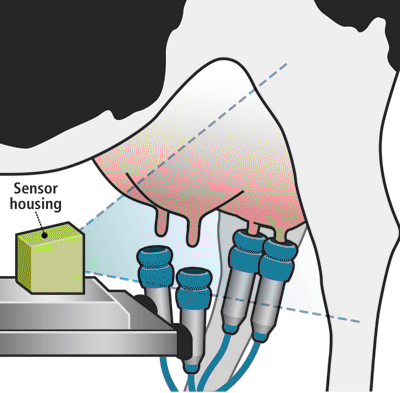
When I first read about automated cow milking machines that use machine vision, I thought it was amusing. Last year, LMI Technologies was working with GEA Farm Technologies to adapt its 3-D time-of-flight imager to the task of producing happier cows and higher yields.

Now I find that robot maker Fanuc Robotics has taken the concept of automated milking to an advanced stage with a herd-milking system that can be seen in this video. Machine vision just keeps getting more interesting.

Now I find that robot maker Fanuc Robotics has taken the concept of automated milking to an advanced stage with a herd-milking system that can be seen in this video. Machine vision just keeps getting more interesting.
Monday, February 8, 2010
BigShot could be a big deal for machine vision
Simpler cameras with embedded intelligence sounds like a good idea. In fact many vendors of smart cameras for machine vision are already heading in this direction, adding FPGAs, DSPs, and CPUs to their products so that their customers can build ever-more sophisticated systems without some of the software development needed for custom applications.
But wait! It seems that a group of 10-year-old kids is working on the same idea. Actually, it’s not quite the same idea since the kids are performing this task using a simple camera kit called BigShot (http://www.bigshotcamera.org/). The creator of BigShot is Shree Nayar, chairman of Columbia University’s computer-science department and director of the Computer Vision Laboratory.
BigShot is a build-it-yourself camera. It comes in a kit with less than 20 parts that snap and screw together simply. When it’s finished, users can peer through the transparent back and, with the help of labels preprinted on the plastic, show curious friends how the camera works. The labels point out the microprocessor, the memory chip, and other features that let this homemade device digitally capture, store, and reproduce images.
BigShot takes normal, panoramic, and even three-dimensional pictures. But the real point of the camera isn’t the photos. It’s to use the camera as an excuse to expose the kids to as many science and engineering concepts as possible.
Nayar worked with a group of contractors to flesh out his initial design and build the first set of working prototypes. He also worked with a group of undergraduate and graduate students at Columbia to develop the online educational materials, design the Bigshot website, and conduct the field tests.
So far there have been test sites in New York City, Bengaluru, India, and Vung Tao, Vietnam, where, the camera has served as a means for children of very different social and economic backgrounds to communicate and express themselves.
What can vendors and integrators of machine-vision products learn from such an undertaking? One lesson, perhaps, is that it is critical to educate young people in science and engineering and encourage some to follow these career paths.
Another is that simplicity and transparency help make technology a more useful tool--whether in education, manufacturing, security, biomedical research, or human relations.
In ways we may not yet recognize, the future success of such machine vision and image processing applications is already being secured by the interest, enthusiasm, and energy of 10-year olds fiddling with do-it-yourself cameras.
Labels:
engineering education,
machine vision,
smart cameras
Subscribe to:
Posts (Atom)